In 2026, rising global labor wages, widespread worker shortages and unstable manual shift efficiency have become the biggest profit threats for block plant owners. Many brick factories face a cruel dilemma: hiring enough operators raises monthly payroll costs sharply, while insufficient workers leads to reduced output, delayed orders and lost engineering contracts.
Most traditional block plants rely heavily on manual pallet feeding, manual brick stacking, frequent material checking and repeated human intervention. The common misunderstanding among factory owners is that more workers equal higher output. In fact, excessive manual operation causes inconsistent production speed, human errors, idle machine time and high defective rates, seriously restricting maximum line capacity.
Block plant labor optimization in 2026 is not about cutting staff blindly. It is about eliminating redundant manual links, upgrading automated auxiliary systems, and standardizing operation workflows. Factories can effectively reduce 40%–60% of on-site operators while maintaining or even boosting daily block output. This guide shares practical, implementable labor optimization strategies for both semi-automatic and fully automatic block lines, suitable for new investors and existing factory upgrades.
1. Why Traditional Block Plants Waste Labor & Limit Output
Before optimizing manpower, factory owners need to identify the core labor-wasting links that drag down production efficiency.
1.1 Dispersed manual processes cause machine idle time
Old production lines require dedicated workers for pallet arrangement, material feeding inspection, finished brick removal and manual stacking. Once one worker slows down or takes a break, the entire block machine has to pause and wait, resulting in low average hourly output even with full staffing.
1.2 Repeated manual inspection leads to low efficiency
Traditional workshops rely on manual checking of material proportion, mold alignment and machine abnormalities. Frequent repeated inspection wastes manpower and cannot avoid human negligence, causing unstable production rhythm.
Many small and medium block plants adopt traditional staffing modes, assigning dedicated workers for each single link. Multiple workers repeat overlapping work, forming serious labor redundancy and raising overall production costs without any output improvement.
2. 2026 Core Labor Optimization Strategies (No Output Loss)
The goal of modern block plant optimization is automate repetitive work, simplify manual operation, and integrate staffing posts. All solutions below ensure stable or increased output while reducing operators.
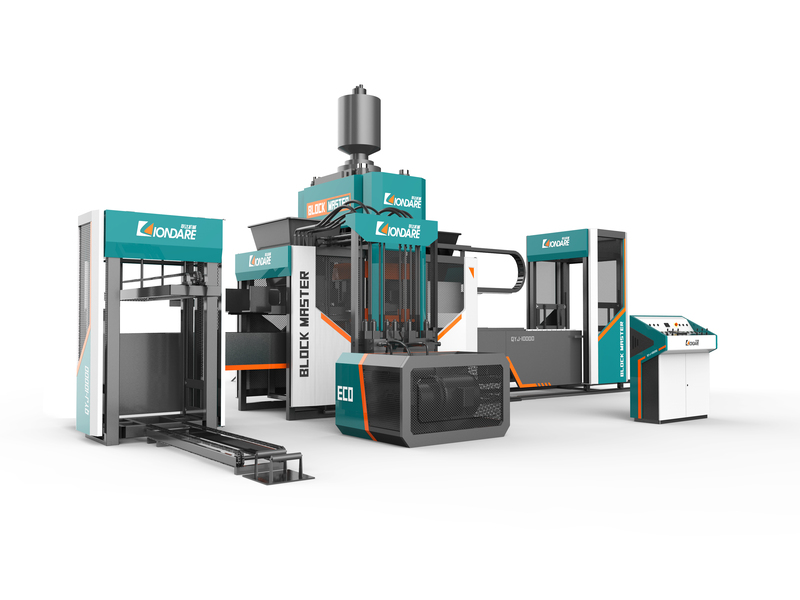
2.1 Upgrade automatic pallet circulation system (Highest ROI upgrade)
Manual pallet arrangement and feeding is the most labor-consuming link in semi-automatic block plants. Installing an automatic pallet magazine and return conveyor completely eliminates 1–2 full-time pallet workers per shift. The system supplies empty pallets continuously and synchronizes with machine molding speed, eliminating machine waiting time and effectively improving overall output stability.
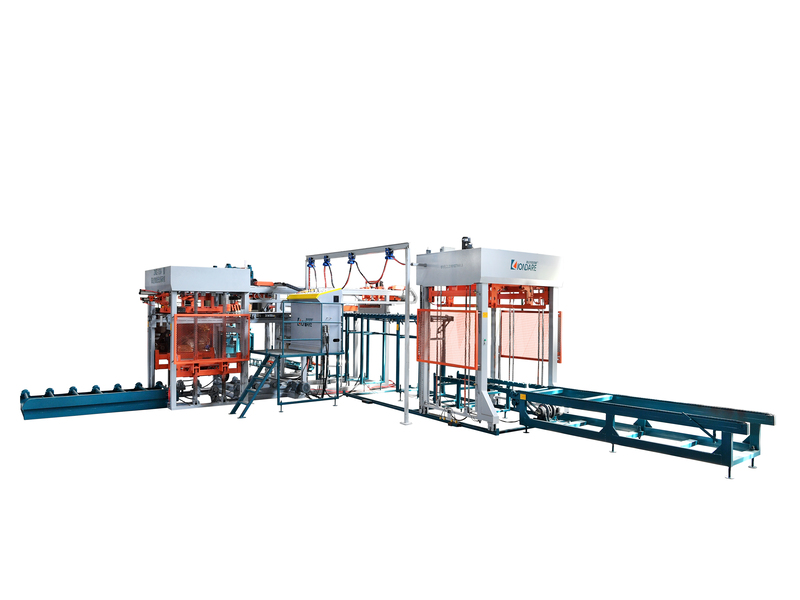
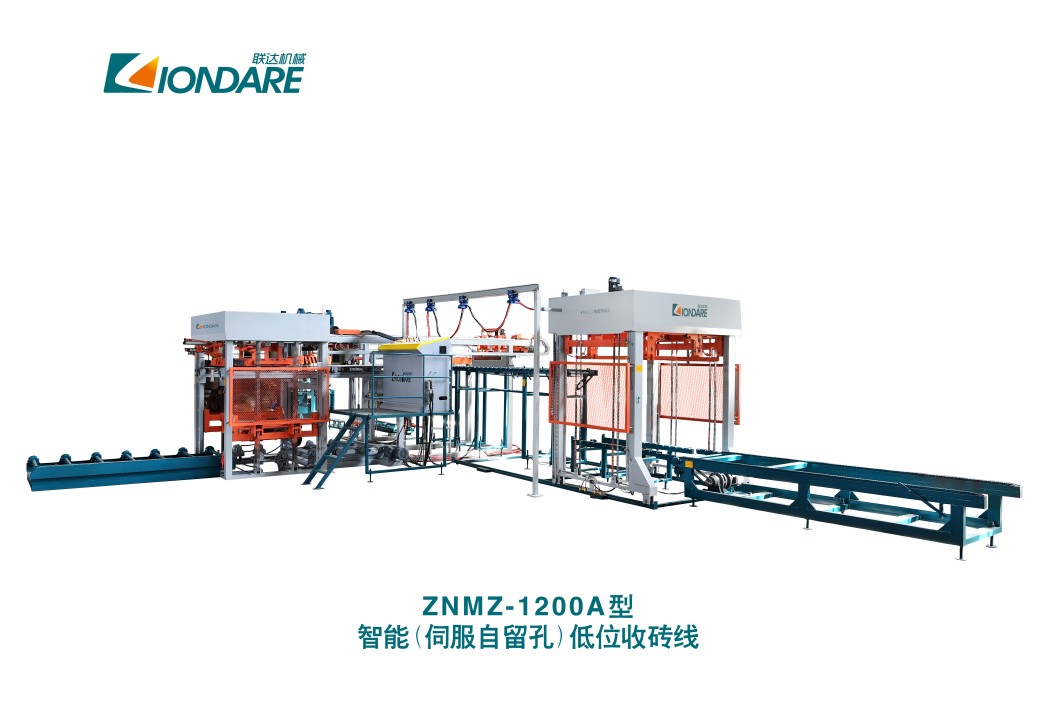
2.2 Add automatic stacking & cubing equipment
Traditional workshops require 2 workers to stack finished wet blocks manually. Upgrading to an automatic brick stacker can replace all manual stacking work. Operators only need to conduct regular inspection and forklift transfer, greatly reducing on-site manpower without affecting continuous production.
2.3 Adopt PLC intelligent centralized control system
Old relay control systems require professional operators to monitor multiple equipment separately. The upgraded unified PLC touchscreen system integrates batching, mixing, molding and conveying control. One single operator can supervise the entire production line, realizing post integration and reducing duplicate staffing.
2.4 Realize automatic batching & feeding linkage
Manual feeding and proportioning not only requires dedicated workers but also causes material errors and unstable brick quality. Automatic weighing and feeding systems ensure precise and continuous material supply, removing the need for manual material watching and frequent feeding adjustment.
2.5 Standardize shift workflow and job integration
Optimize job responsibilities, merge repetitive inspection and auxiliary work, and train multi-skilled operators. Avoid one-person-one-post rigid staffing. Standardized operation SOPs reduce human errors and keep production speed consistent all day long.
3. Manpower Comparison: Traditional vs Optimized Block Plant (2026 Standard)
3.1 Traditional semi-automatic line (Before optimization)
Total operators per shift: 4–5 workers Job allocation: Pallet feeding (2 workers), material feeding monitoring (1 worker), finished brick stacking (2 workers), simple inspection Problem: High labor cost, easy machine idle, unstable daily output
3.2 Optimized semi-automatic line (After upgrade)
Total operators per shift: 2–3 workers Optimization result: Automatic pallet system + semi-automatic stacking replaces 2–3 manual workers; remaining staff only undertake supervision and auxiliary work Advantage: Daily output remains stable or increases by 10%–20%, labor cost reduced by over 40%
3.3 Fully automatic optimized production line
Total operators per shift: Only 1–2 supervisors All core links are fully automated, no heavy manual handling. Suitable for large-volume factories with high local labor costs, achieving maximum profit margin.
4. Common Optimization Mistakes That Cause Output Decline
Blind staff reduction: Cutting workers without matching automated upgrades leads to insufficient manual auxiliary work, causing machine jamming and output drop.
Incomplete automation upgrade: Only upgrading the main machine without supporting pallet and stacking automation cannot fundamentally solve labor bottlenecks.
Lack of operator training: New intelligent systems require standardized operation. Untrained staff cannot maximize equipment efficiency, resulting in low output after optimization.
Unreasonable post merging: Excessively compressed staffing leads to operator fatigue and missed inspection, increasing defective rate and hidden downtime risks.
5. Long-Term Benefits of Labor Optimization for Block Plants
Stable daily output: Automated auxiliary systems run stably 24/7 without fatigue, avoiding output fluctuations caused by worker rest, mood or skill differences.
Lower defective rate: Reduced manual intervention minimizes operation errors, making block size, density and quality more uniform, easier to pass engineering inspections.
Stronger anti-risk capability: Effectively avoid production shutdowns caused by worker resignation, labor shortage and rising wages, ensuring long-term stable factory operation.
Higher profit margin: Reduced recurring labor costs bring continuous profit growth, helping factories gain price advantages in market competition.
Final Conclusion
In the competitive 2026 block manufacturing industry, labor cost control and stable output are the two core factors determining factory profitability. Traditional relying on manual stacking and pallet feeding is no longer in line with modern factory operation standards.
Scientific labor optimization through automated pallet circulation, intelligent control system upgrade and reasonable post integration can help block plants reduce 40%–60% of operators while maintaining and even improving daily output. It is the most low-risk, high-return transformation solution for both new factories and old production lines.
Our team provides customized block plant labor optimization schemes, including equipment retrofit suggestions, staffing adjustment plans and operator SOP training. Contact us to get a free factory manpower evaluation and exclusive optimization solution.
FAQ
Q1: Can block plants really reduce workers without lowering production output?
A: Yes. Output loss is mainly caused by machine idle time and inconsistent manual operation speed. By upgrading automatic pallet circulation, stacking systems and PLC centralized control, factories can eliminate manual bottlenecks, stabilize production rhythm, cut redundant operators by 40%–60%, and even increase daily output by 10%–20%.
Q2: How many workers can a optimized semi-automatic block line save in 2026?
A: Traditional semi-automatic lines need 4–5 operators per shift. After targeted labor optimization and auxiliary equipment upgrades, only 2–3 multi-skilled supervisors are required. Factories can save 2 or more full-time workers per shift, greatly reducing monthly labor payroll expenses.
Q3: What is the most cost-effective labor optimization upgrade for old block plants?
A: Installing an automatic pallet magazine and return conveyor system is the best low-cost, high-ROI upgrade. It directly replaces manual pallet feeding workers, eliminates machine waiting idle time, improves production continuity, and usually recovers retrofit costs within 12 months.
Q4: Will fewer operators cause higher block defective rates?
A: No. Defective blocks are mostly caused by human errors in feeding, pallet placement and parameter adjustment. Optimized automated production reduces manual intervention, stabilizes vibration, pressure and material proportion parameters, and effectively lowers the defective rate instead of increasing it.
Q5: How many workers does a fully automatic optimized block production line need?
A: A standard fully automatic closed-loop block line only requires 1–2 on-site operators per shift, mainly responsible for equipment monitoring, routine inspection and minor adjustments. It completely eliminates heavy manual handling work and is highly suitable for regions with high labor costs and labor shortages.
Если вы заинтересованы в нашей продукции и хотите узнать более подробную информацию, пожалуйста, оставьте сообщение здесь, мы ответим вам, как только сможем.



 One kilometer away from the exit of Nanshi Expressway in Rongqiao Project Concentration Area, Nan'an City
 Электронная почта
: admin01@liandamachine.com
Электронная почта
: admin01@liandamachine.com


 Поддерживается сеть IPv6